
I am really proud of my latest article, which has just been published in Physical Review B (DOI: 10.1103/PhysRevB.109.075406). It outlines a novel method to quantify numerically the symmetry of the eigenmodes returned by a simulation, which allowed me to optimise for mode symmetry in a genetic algorithm that designs metasurfaces.
It is a very simple method to apply to any dielectric photonic system, where the field can be characterised by the in-plane vector field. It returns not just a symmetry (irreducible representation) for a given mode, but also a fractional value for each of the irreducible representations. This means that we can tell if two modes are coupled by the fact that they have matching fractional values of two different symmetries.
The technique should be useful in any case in which symmetry is important – Which nowadays is pretty much every case.
I worked out this technique while working on a DARPA project involving four institutions in the US and Australia. In this project we are collaborating to evaluate whether metasurfaces and up-converting nanoparticles can be used to create night vision systems that would resemble glasses rather than the bulky optical devices currently in use. This is an important development for the health of soldiers since the current devices exert a significant torque on the soldier’s neck and can thus cause strain injuries. The applications also extend beyond defence to civilian use as well.
How it works
To explain the technique a little further, let’s suppose that you are characterising a metasurface mode by its out of plane field,  . We would take a sample of values over a plane that cuts through the center of the metasurface to give us a matrix of values. Instead of representing the values as a matrix though, it is also possible to represent them by a vector:
  . Each element of this vector corresponds to one sample point, which becomes a dimension of our vector space.
What is really remarkable here is that by careful choice of basis it is possible to divide this vector space into a set of subspaces – or hyperplanes – where each subspace corresponds to a particular irreducible representation of the point group in question (and it could be any point group at all). That is, if we create a random vector within the hyperplane that corresponds to the 
 irreducible representation then the image represented by that random vector is guaranteed to have symmetry. This applies to any image at all, not just E fields, and could be expanded to 3D if you have sufficient memory.
This then gives us a way to tell if a mode has a given symmetry by seeing if it has any projection onto the hyperplane corresponding to that symmetry. The way to do this ofcourse is by using the linear algebra of projection operators, or projectors. That is, to see if  has any component we apply the appropriate projector to it to get the vector that is its projection onto that symmetry; ie
(1) 
where  is the projector for the symmetry.
We can see an example of this in the image at the top of this post. In figure (a) we can see a symmetric field, and in (b) we see the result of applying the projector onto it. It is difficult to see in this image, but fig. (b) is actually cleaner than fig. (a) since everything that is not symmetric has been removed by applying the projector. In figure (c) on the other hand we can see the effect of applying the  projector, which effectively reduces the field to zero since the maximum value is reduced by over 2 orders of magnitude. Note that the resulting image has symmetry (i.e. it has symmetric mirrors horizontally and vertically, but antisymmetric diagonally and anti-diagonally), as it must if the projector gives a vector in the hyperplane. Finally, in figure (d) we see the effect of applying a
  projector which again reduces the original symmetric field in fig. (a) to near zero. Again, the resulting image has symmetry.
This then allows us to define a symmetry parameter of
(2) 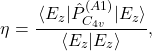
which has a range of 0 to 1 inclusive. Allowing for numerical error, if has symmetry then we will get a value of 1 for the symmetry parameter and a value of 0 when any of the other four projectors of are used. Therefore, because we have numerically quantified the symmetry of the mode we can now include the mode symmetry in optimisation routines.
Fractional values
A useful feature of the symmetry parameter is that one can get fractional values. Now, if a metasurface has symmetry of then every mode will have the symmetry of one of the irreducible representations of . That is,  will give a value of either 1 or 0 for each of these irreducible representations – usually.
One case where we can get fractional values is when two modes are coupled. If the two modes have, say,  and symmetry then when they couple each mode will have fractional values for and symmetry, with the total adding up to 1. We can therefore tell if two modes have coupled by their fractional values for symmetry.
Another case where we can get fractional values is when we change the incident angle for the illuminating beam. If a metasurface has symmetry at the  -point its symmetry will correspond to a different point group in the rest of the Brillouin zone, say
  . But the eigenmodes of a metasurface have the symmetry of one of the irreducible representations of the point group, so away from the -point the modes will correspond to irreducible representations of the new point group . Therefore, if we analyse the whole Brillouin zone in terms of then we might get fractional values for eta away from the -point.